Category: Uncategorized

  • Foam Fingers vs. Thundersticks vs. Rally Towels: Choosing a Stadium Giveaway

    Foam Fingers vs. Thundersticks vs. Rally Towels: Choosing a Stadium Giveaway

    The best stadium giveaway is the one that survives the drive home. Foam fingers, thundersticks, and rally towels all put a logo in tens of thousands of hands on game day, but they behave very differently once the final whistle blows — and they cost, print, and pack very differently before it. If you are choosing between them for a team night, a sponsor activation, or a campus event, the decision comes down to four practical variables rather than gut feel.

    What each one is actually good at

    A rally towel is a flat, sublimated cloth that a fan waves overhead and then keeps in a gym bag for years. A thunderstick is a pair of inflatable plastic tubes that make noise and cost almost nothing, but they are loud precisely because they are disposable. A foam finger is the giveaway with physical presence: it is large, it photographs well on a broadcast crowd shot, and it becomes a souvenir rather than trash. None of the three is strictly better; they occupy different points on the same axes of cost, branding space, and keepsake value.

    Getting the match right matters because the giveaway is standing in for your brand. A sponsor who hands out something fans quietly discard has paid for a few seconds of visibility. One who hands out something fans photograph and keep has bought weeks or years of it. The rest of this comparison puts numbers to that trade.

    Cost and quantity

    Unit price is where the three separate most sharply. Inflatable thundersticks are the budget option by a wide margin, commonly landing under a dollar per stick in bulk, which is why they suit giveaways in the tens of thousands where the only goal is noise and a splash of color. Foam fingers and rally towels sit in a similar, higher band — indicatively $1.50 to $4.00 or more each in volume — because both carry a real print and a real physical footprint.

    Those figures are the piece price only. Screen or sublimation setup fees, art charges, and freight all sit on top, and freight in particular scales with bulk and weight: towels and foam fingers ship heavier and larger than deflated sticks, so a five-figure order can shift a full freight class. When you compare quotes, compare landed cost per usable unit, not the headline piece price, because the cheapest sticker rarely stays cheapest once setup and shipping are added.
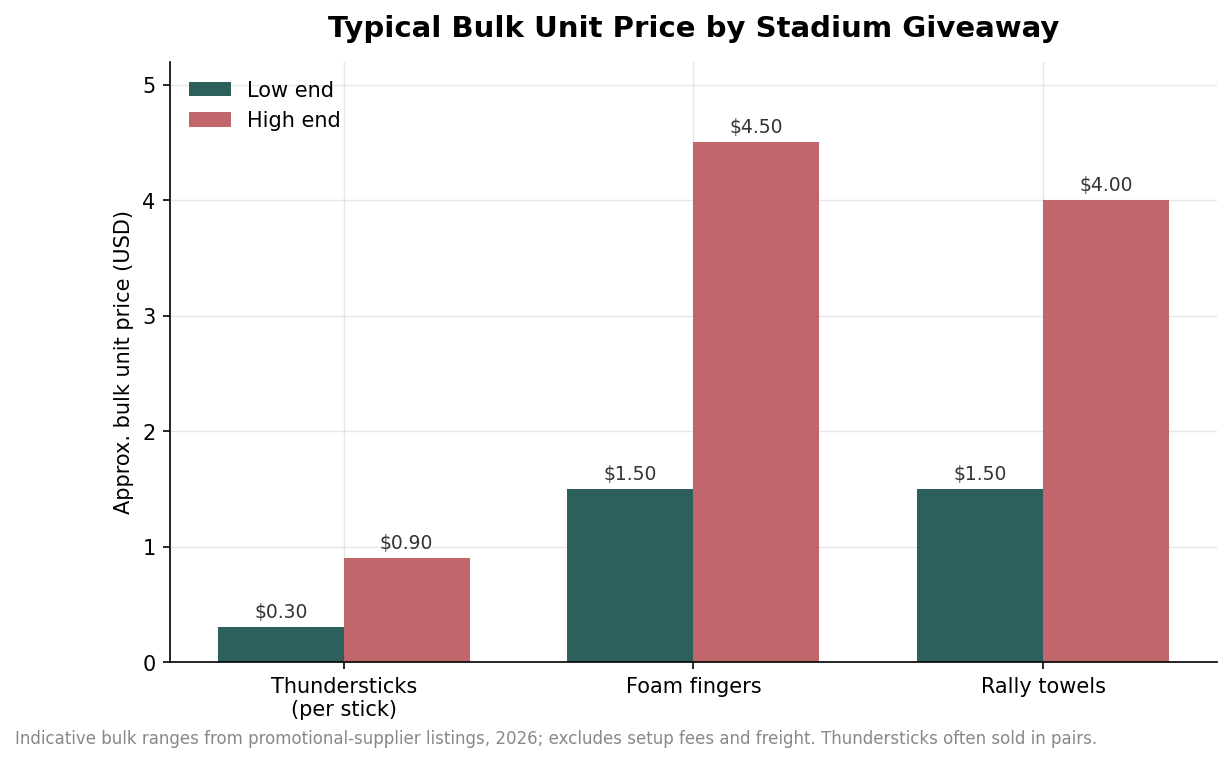
    Grouped bar chart of low and high bulk unit prices for thundersticks, foam fingers, and rally towels
    Thundersticks win on unit price; foam fingers and towels share a higher band that buys print and presence.

    Imprint area and print quality

    Branding space is where foam fingers and towels pull ahead. A rally towel prints edge to edge by dye sublimation, so an 11 by 18 inch towel offers roughly 198 square inches of full-color, photo-quality canvas with no per-color fee. A foam finger gives you a large single panel on each side — on the order of 75 square inches of usable space — that holds a bold logo and a short message cleanly. A thunderstick, by contrast, prints on a narrow, curved face that limits art to something simple; complex logos distort on the tube, and effective imprint area is a fraction of the other two.

    The lesson is to match artwork to surface. A detailed, multi-color sponsor lockup belongs on a towel or a foam finger, where it will actually read. A single-color wordmark or a school color block is all a thunderstick can carry well, and trying to force more onto it produces a muddy result that undercuts the whole point of the giveaway.
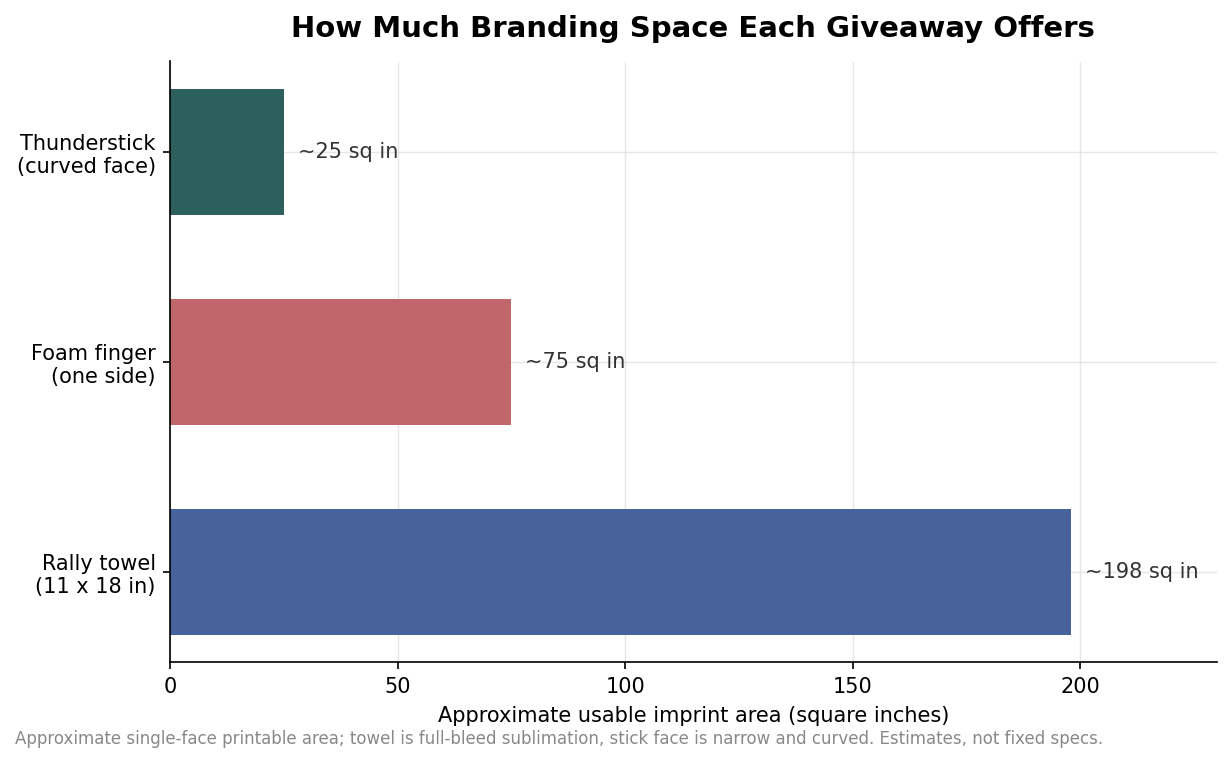
    Horizontal bar chart comparing approximate usable imprint area for a thunderstick, foam finger, and rally towel
    Usable branding space rises sharply from a thunderstick’s curved face to a full-bleed rally towel.

    Keepsake value and the fan’s twenty-four hours

    The sharpest difference is what happens after the event. Industry write-ups on game-day promotions note that thundersticks are frequently discarded within about a day, while a well-made rally towel can stay in circulation for years. Foam fingers land between the two but far closer to the towel: they are bulky enough to be a deliberate keepsake, they show up in photos, and they tend to migrate to bedroom walls and office shelves rather than the bin. If your measure of success is impressions per dollar over time rather than noise in the moment, longevity is the variable that quietly decides it.

    That does not make thundersticks a mistake. For a playoff whiteout or a coordinated crowd effect across a full arena, cheap and loud is exactly the brief, and reusability is beside the point. The error is using disposable economics for a keepsake goal, or keepsake economics for a one-night noise effect. Decide which you are buying before you compare prices.

    Matching the giveaway to the event

    Work backward from the outcome you want. If the goal is a dramatic, arena-wide visual on the cheapest possible budget and you are giving away enormous quantities, thundersticks earn their place. If the goal is a durable, full-color canvas that fans keep and re-use, a rally towel is hard to beat, and its 100-unit minimums make it viable even for smaller programs. If the goal is broadcast presence, a memorable souvenir, and a big readable logo — the item a kid actually wants — a foam finger delivers physical impact that neither of the others matches, at a comparable unit cost to a towel.

    Most programs do not have to choose only one. A common pattern pairs a low-cost noise item for the full crowd with a smaller run of a premium keepsake for a specific section, sponsor tier, or giveaway night. Whatever mix you land on, put the real numbers — landed unit cost, usable imprint area, and expected lifespan — next to each other before you commit. The giveaway that looks cheapest on a quote is not always the one that carries your brand the furthest.
  • Foam Finger Shapes Beyond the #1: Choosing the Right Style for Your Event

    Foam Finger Shapes Beyond the #1: Choosing the Right Style for Your Event

    The pointing #1 hand is what most people picture when they hear “foam finger,” and for good reason: it reads from the back row of an arena and it has meant one thing for decades. But if you are ordering a custom run for a brand activation, a school spirit store, or a trade show booth, the single upraised finger is only the starting point. Foam hands come in a wide family of die-cut shapes, each of which sends a slightly different signal and photographs differently in a crowd. Choosing the right one is less about cost and more about the gesture you want thousands of people making at once.

    This guide walks through the main style families, how their sizes and prices compare, and how to match a shape to the moment you are printing for.

    The classic pointing hand, and where it still wins

    The traditional #1 finger is the workhorse. In its full-size form it typically stands around 15 to 18 inches tall, which is large enough to carry a logo the length of the forearm and still be legible on a broadcast wide shot. It is the default for team sections, championship giveaways, and anywhere the message is simply “we’re number one.” Because it is the highest-volume shape across the industry, it is also usually the easiest to source quickly and often the lowest cost per unit at a given size. If your goal is maximum visibility for a single rallying idea, the pointing hand is hard to beat and rarely the wrong answer.

    Where it falls short is nuance. A #1 finger says one thing. If your campaign has a specific gesture, mascot, or product shape you want in people’s hands, a die-cut style will do more work for you.

    Mitts and die-cut shapes: matching the gesture to the brand

    Beyond the pointing hand sits a large catalog of foam mitts and die-cut hands. Common stock shapes include the thumbs-up, the high five (an open palm), the peace or victory sign, the “hang loose” shaka, and sport-specific cuts like a boxing glove, a basketball, a paw print for animal mascots, a shark fin, and a heart. Some vendors also stock an L-shape and other novelty cuts. Each of these is essentially a flat foam shape printed on both faces with a slit or pocket so a hand slides in, and each one turns a crowd into a wall of the same gesture.

    The strategic value is that the shape itself becomes part of the message before anyone reads the print. A paw print for a Wildcats section, an open palm for a “high five to the grads” alumni night, a heart for a charity walk: the die cut does the branding, and your logo confirms it. If none of the stock shapes fit, most manufacturers will cut a fully custom silhouette from your outline, though that adds a one-time die or tooling charge and usually pushes lead times and minimums higher than a stock shape would.

    Sizing across styles, from mini wavers to jumbo

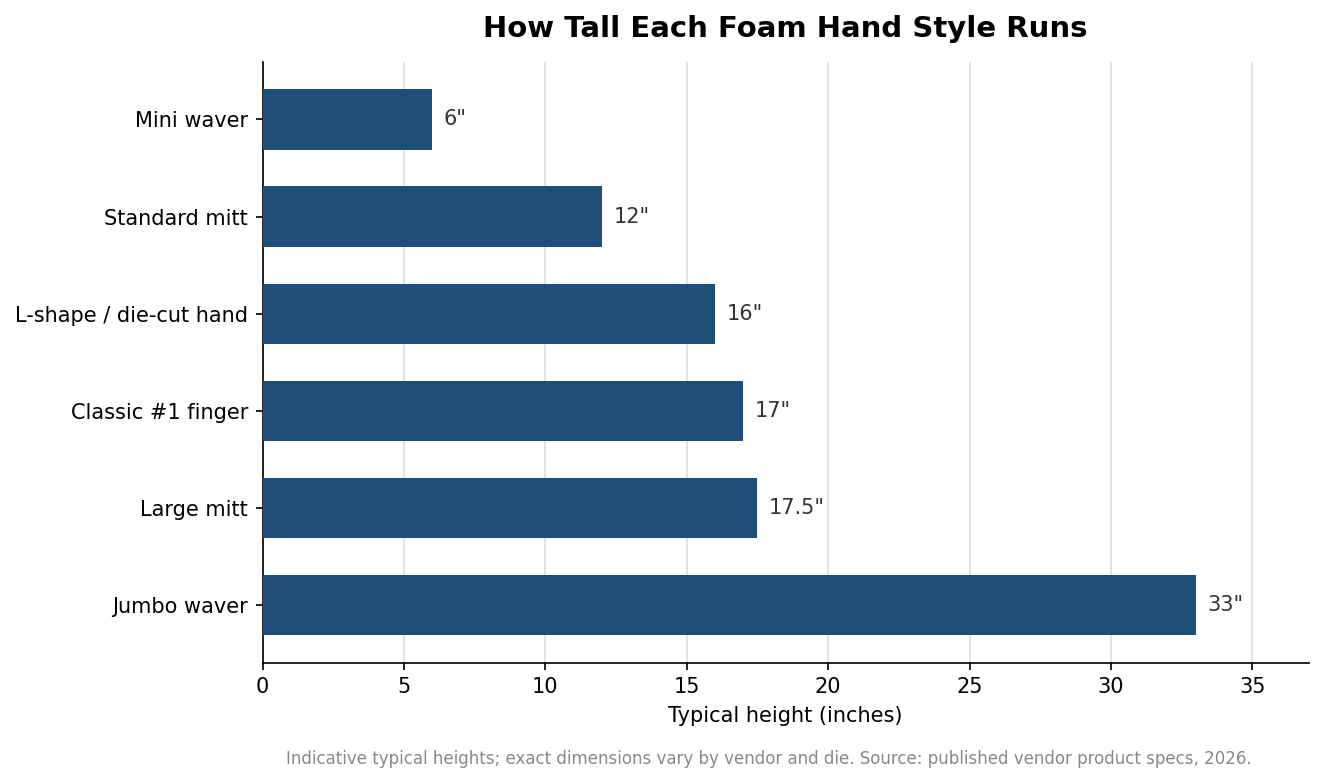
    Size is where these styles diverge the most, and it matters for both impact and shipping. At the small end, mini wavers run around 6 inches and are built to be handed out by the thousands as cheap, packable giveaways. Standard mitts land in the 8-to-12-inch range, full pointing hands around 15 to 18 inches, and jumbo novelty wavers can reach roughly 33 inches for a piece designed to dominate a photo. The chart below shows the typical spread; treat the numbers as indicative, because every vendor cuts to slightly different dies.

    Horizontal bar chart comparing typical heights of foam hand styles from a 6-inch mini waver to a 33-inch jumbo waver
    Typical height by style, from mini waver to jumbo; exact dimensions vary by vendor.

    The practical trade-off is straightforward: bigger shapes command attention and carry more print area, but they cost more per piece and ship in far larger cartons. For a stadium giveaway where budget and freight are the constraints, a mid-size hand is often the sweet spot. For a hero photo or a stage moment, the jumbo earns its keep even at low quantity.

    What each style costs, and how quantity moves the price

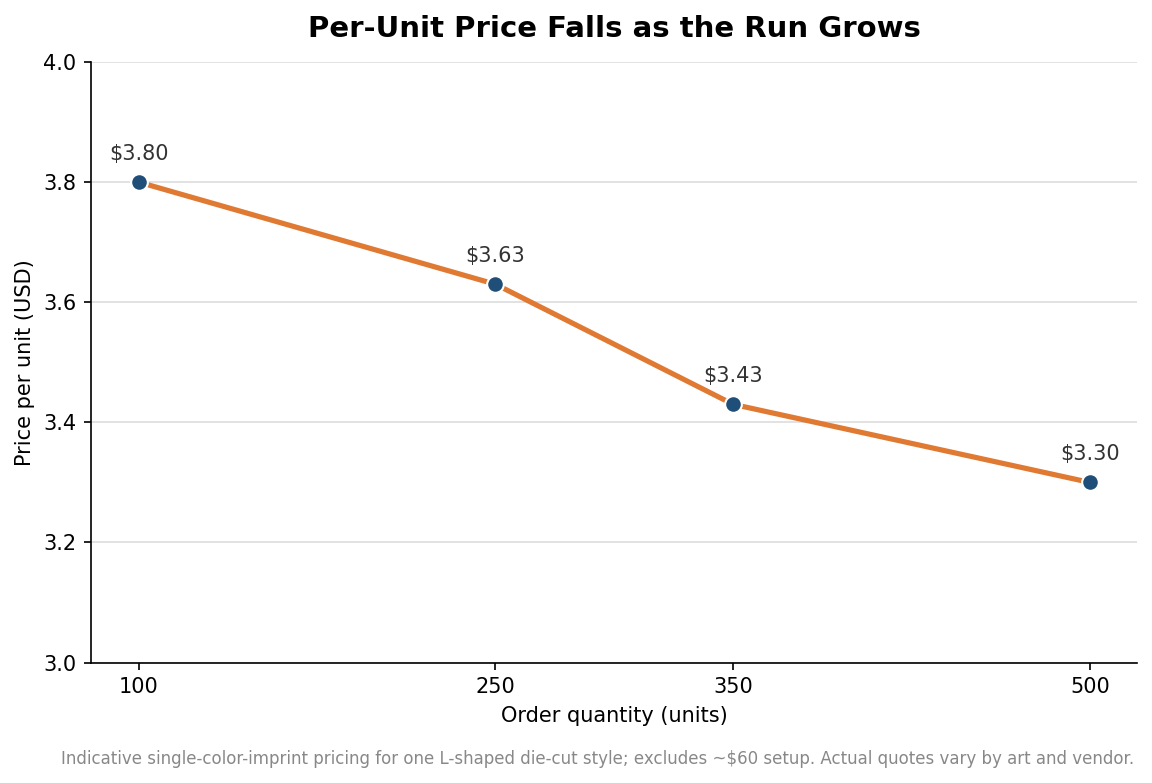
    Pricing tracks size, print complexity, and above all quantity. As an order-of-magnitude picture, small wavers can run well under a dollar each in volume, standard hands and mitts commonly fall in the roughly $1 to $4 per unit band for a single-color imprint, and large or fully custom die-cut pieces sit higher. Nearly every vendor also charges a one-time setup or screen fee in the neighborhood of $50 to $60 per color and location, which is why per-unit price drops sharply as the run grows and that fixed cost spreads out. The line below, drawn from one published die-cut price schedule, shows how a run climbing from 100 to 500 units pulled the per-piece price down from about $3.80 to $3.30.

    Line chart showing per-unit price of a die-cut foam hand falling from $3.80 at 100 units to $3.30 at 500 units
    Per-unit price falls as the order grows and the fixed setup fee spreads out.

    Two things follow from this. First, small orders are dominated by setup fees, so if you can consolidate several events into one print run you will save real money. Second, added colors and second-side printing each carry their own charges, so a two-color logo on both faces is a meaningfully different quote than a one-color front. Ask for pricing at the exact quantity and imprint you expect, not a round number, because the breakpoints move the math.

    Materials, safety, and matching the style to your event

    Across shapes the construction is similar: an open-cell foam, most often a polyurethane, cut and printed on both faces. For indoor arenas and any audience that includes children, look specifically for foam described as flame-resistant and inks described as phthalate-free, both of which reputable manufacturers will state plainly; if a listing does not mention them, ask before you commit. Print is typically a one-color screen imprint as standard, with full-color heat transfer available as an upgrade when your art demands it, at a per-unit run charge on top of the base price.

    Putting it together, the style choice comes down to the job. Choose the classic pointing hand when you want one loud, universal message and the fastest, cheapest path to a big crowd. Choose a stock mitt when a recognizable gesture, thumbs-up, paw, heart, or open palm, does branding work the print alone cannot. Reserve a fully custom die cut for campaigns where the silhouette itself is the hook and the budget and timeline allow the extra tooling. Match the size to whether you are optimizing for giveaway volume or for the photograph, get a quote at your real quantity and imprint, and the shape that fits your event will usually be obvious once you have framed it that way.

  • How to Set Up Artwork for Custom Foam Fingers So the Print Comes Out Right

    How to Set Up Artwork for Custom Foam Fingers So the Print Comes Out Right

    Most foam finger orders that disappoint do not fail at the press. They fail on the artwork, days earlier, when a logo goes in as a low-resolution image, a font drops out because it was never outlined, or a design gets drawn to the edge of a die that trims part of it away. The print is only ever as good as the file you hand over. Spending twenty minutes setting the artwork up correctly is what separates a clean, on-brand run of a few hundred pieces from a reprint you pay for twice.

    This is a step-by-step walkthrough of the specifications that matter, in the order you should decide them, so the foam finger you approve on screen is the one that ships.

    Start with the die shape and finished size

    The die shape defines your usable print area, so choose it before you design anything. A pointing-hand foam finger is not a rectangle, and the printable zone follows the outline of the hand, not the bounding box around it. Artwork drawn to the far edges of the shape risks landing on a curve or getting clipped where the die cuts. Keep type and critical logo elements inside a safe margin, roughly a quarter inch to half an inch in from the cut line, and treat the wrist or base panel as your most reliable flat area for text.

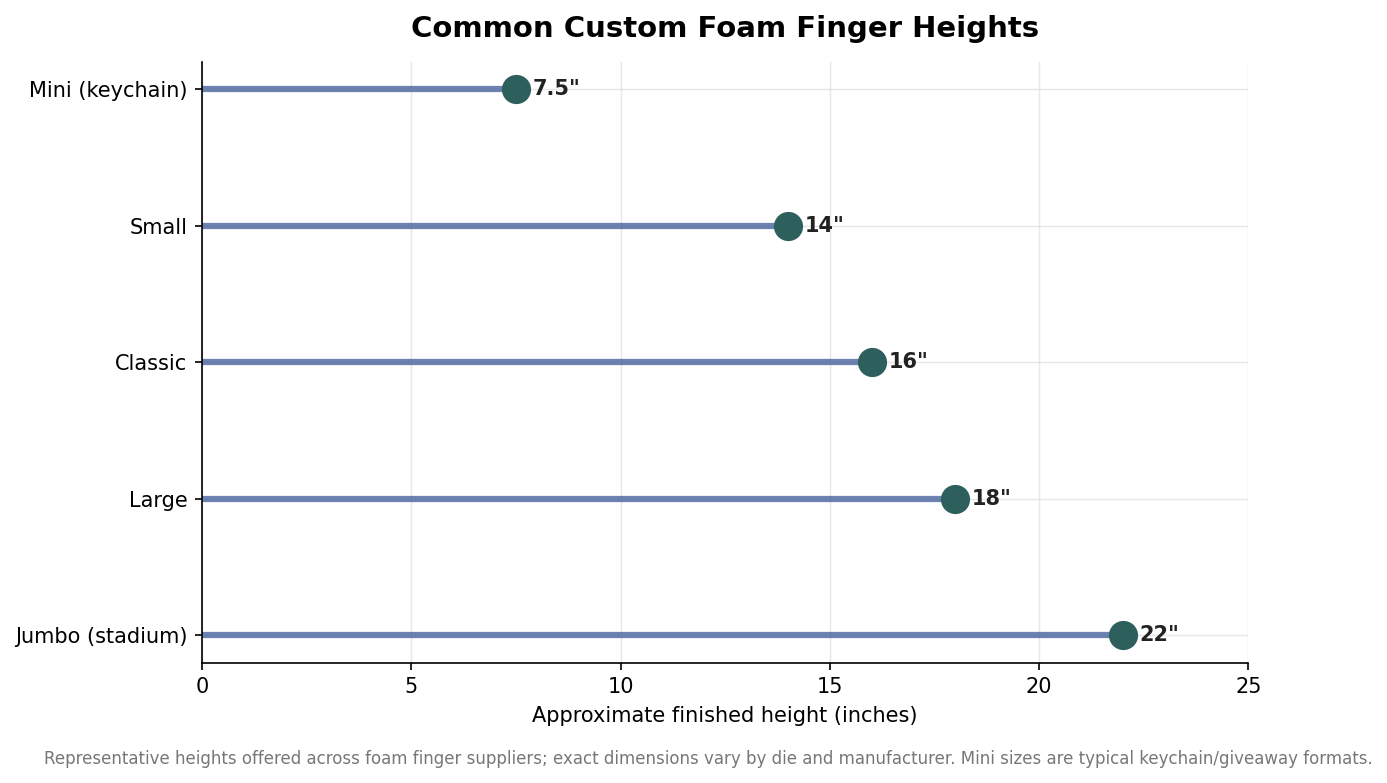
    Size comes next because it sets how much detail actually reads. Foam fingers commonly run from about 7.5 inches for mini keychain and giveaway formats up to roughly 22 inches for the jumbo stadium size, with 14 to 18 inches covering most classic hands. A design that looks sharp at 18 inches can turn muddy at 7.5, so if you are ordering a mini alongside a full-size hand, simplify the small version rather than shrinking the same file.

    Lollipop chart of common custom foam finger heights from 7.5 inch mini to 22 inch jumbo
    Foam finger heights range from mini keychain formats to jumbo stadium sizes; detail must be simplified for smaller sizes.

    Supply vector art and outline your fonts

    Build the artwork in vector format. Suppliers typically want an SVG or a high-resolution vector PDF, and a raster fallback should be a PNG at 300 DPI at final print size, not a screenshot pulled off a website. Vector art scales from a mini to a jumbo without softening, which matters precisely because the same logo may run across several sizes.

    The single most common file problem is fonts. Convert every piece of text to outlines or curves before you send the file, so the letterforms travel as shapes rather than depending on a font the printer may not have installed. If you skip this step, the shop either has to source your exact typeface or substitutes a different one, and a substituted font can quietly change your spacing and line breaks. Outlining also locks your kerning in place, which protects a wordmark from being reflowed. Send the fonts along too if the supplier asks, but outline first.

    Spot color or full color: decide before you design

    How your art is colored changes both the file you build and the price you pay. Spot-color printing reproduces a set number of solid, named colors, usually specified as Pantone (PMS) values, and it is the right choice for a clean logo made of a few flat colors. Because each color is a separate screen, cost tends to rise with the number of colors, and very fine gradients are not its strength. If you go this route, put the exact PMS numbers in your file or your notes rather than leaving the shop to guess from an RGB screen color, which will not match.

    Full-color, or process, printing reproduces photographic images and complex gradients by building them from blended inks, and it is what you want for a detailed illustration, a photo, or a design with many colors. The trade-off is that flat brand colors can drift slightly from a Pantone target under process printing, so if an exact corporate color is non-negotiable, say so up front and expect the shop to steer you toward spot color for that element. Deciding this before you design saves you from building a gradient-heavy file for a two-color budget, or vice versa.

    One printed side or two

    Foam fingers can be printed on a single side or on both, and the two options are not the same order. Single-sided printing puts your design on the face that points at the camera or the jumbotron and leaves the back blank or in the stock foam color. Double-sided printing decorates both faces, which is worth it when the finger will be seen from behind as often as the front, such as a crowd shot where half the hands are turned away.

    Double-sided work generally adds cost and can add a little to the lead time, because it is effectively two print setups on one piece. A frequent and cheap compromise is a full design on the front and a simple one-color logo or hashtag on the back. Decide this early, because it affects your artwork deliverables: a double-sided order needs two files, and the back design should be built to the same safe-margin rules as the front.

    Foam, minimums, and the quantities behind your price

    The physical build is worth understanding because it shapes both feel and cost. Foam fingers are typically die-cut from EVA foam around 2 to 3 millimeters thick per layer, giving a total product thickness in the range of 4 to 6 millimeters once the front and back are bonded. Thicker foam feels more substantial and holds its shape better in a waving crowd; thinner foam trims cost but can feel flimsy, so it is a spec worth confirming rather than assuming.

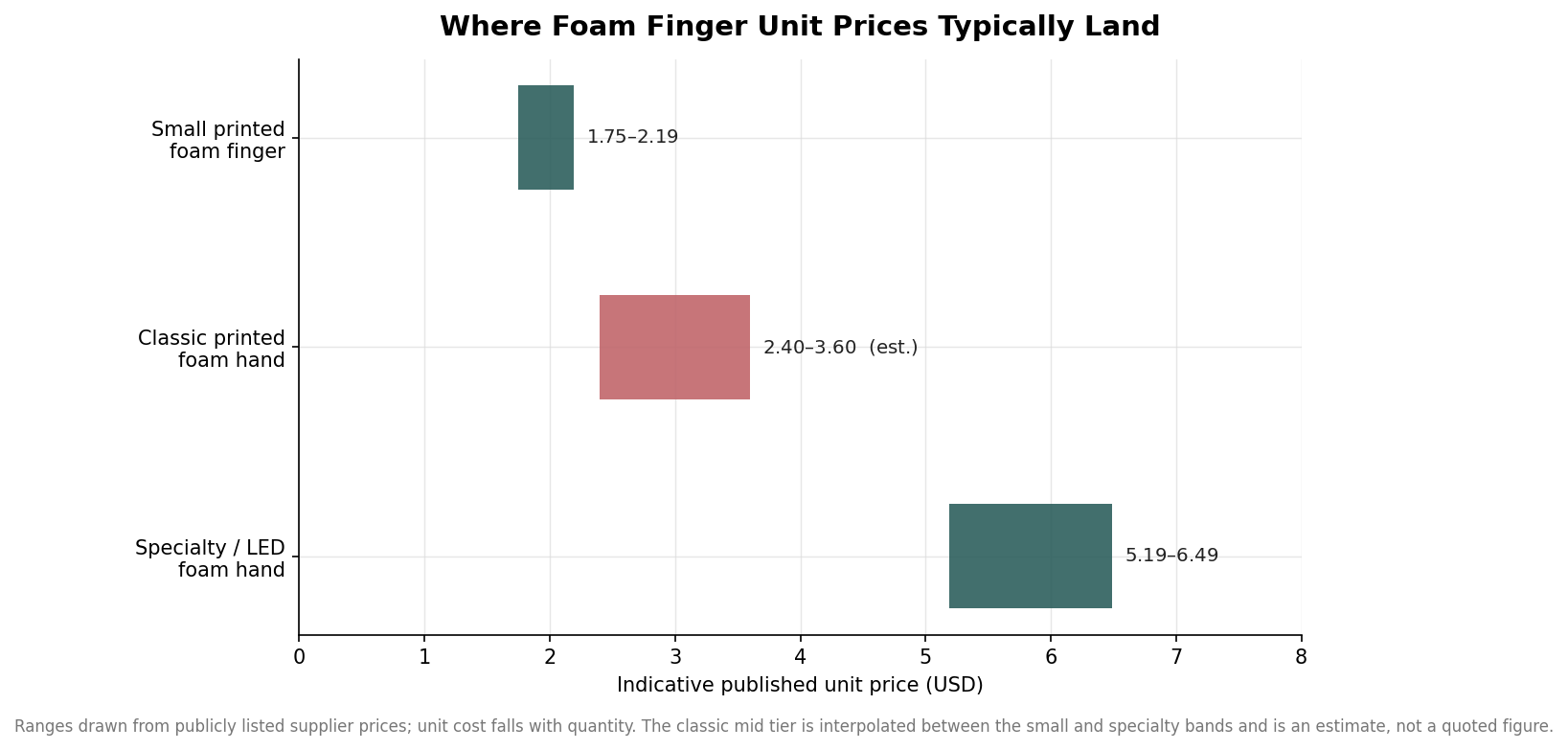
    Quantity is where the economics live. Stock die shapes commonly carry minimums around 100 pieces, while a fully custom die-cut shape often starts near 500 pieces because the shop has to make tooling for your outline. Lead times run roughly 10 to 12 days after art approval for stock shapes and 16 days or more for custom dies, so back-plan from your event date and leave room for a proof. Unit prices published across suppliers land in the low single dollars for small printed fingers and climb toward five or six dollars for specialty and LED hands, with the exact figure falling as quantity rises; treat the ranges below as indicative rather than a quote.

    Floating range bar chart of indicative published unit prices for small, classic, and specialty foam hands
    Indicative published unit-price bands by product type; the mid tier is an interpolated estimate.

    Put together, the sequence is straightforward: pick the die and size, build clean vector art with outlined fonts, choose spot or full color to match your design and budget, decide one side or two, and confirm the foam thickness and quantity that set your price and timeline. Every one of these is a decision you make before anything is printed, which is exactly why they are the cheapest place to get a foam finger order right. Ask for a physical or digital proof before the full run, and check it against this list rather than against the version in your head.

  • Hello world!

    Welcome to WordPress. This is your first post. Edit or delete it, then start writing!

  • How Many Foam Fingers Should You Order?

    Call or Text us: (929) 605-4397

    HomeBlog › How Many Foam Fingers Should You Order?

    Ordering

    How Many Foam Fingers Should You Order?

    06/12/2026

    Deciding how many custom foam fingers to order is the first question every buyer hits — and getting it roughly right saves both money and headaches. Order too few and you run out during the second quarter; order too many and they sit in a closet.

    Here’s the practical framework we walk every customer through, from stadium-wide giveaways to boutique fundraisers.

    Start with your venue or audience

    The cleanest starting point is capacity. For a stadium-wide giveaway, base your number on paid attendance, not total seats, and add a 5–10% buffer for staff, VIPs, and extras. For a student section or fan club, use your active membership plus expected walk-ups.

    Match quantity to the goal

    A give-one-to-everyone handout needs full coverage; a merch or fundraiser item only needs to match expected sell-through — usually 15–30% of attendance for a paid item.

    ScenarioTypical quantityBest style
    Youth league / school event100–500Mini Foam Finger
    Student section giveaway1,000–5,000Classic #1 or Die-Cut
    Pro stadium giveaway night10,000–25,000+Classic #1
    Team store / fundraiser250–1,000Mini or Classic #1
    Corporate / sponsor activation500–2,500Full-Color or Jumbo

    Choosing for your order

    When in doubt, round up to the next price break — the per-unit cost usually drops enough at the next tier that the extra units are nearly free, and leftover foam fingers keep for the next event.

    Key takeawayFor give-to-everyone events, order paid attendance + 10%. For merch and fundraisers, order 15–30% of attendance.

    Ready to put your brand in every hand? Get a custom quote — free mockups in 24–48 hours. Learn more about how we work, or browse more guides.

    More posts

  • Screen Print vs. Full-Color Foam Fingers: Which to Choose

    Call or Text us: (929) 605-4397

    HomeBlog › Screen Print vs. Full-Color Foam Fingers: Which to Choose

    Buyer guides

    Screen Print vs. Full-Color Foam Fingers: Which to Choose

    06/05/2026

    The single biggest decision on a foam finger order isn’t the shape — it’s the decoration method. Screen printing and full-color dye printing produce very different results at different price points.

    Here’s how to pick the right one for your logo, budget, and timeline.

    When screen printing wins

    Screen printing lays down one or two spot colors of ink cleanly and cheaply. If your logo is one or two solid colors — most team crests and wordmarks are — screen printing gives you the crispest, most economical result, especially at high volume.

    When full-color wins

    Full-color dye printing reproduces gradients, photographs, and unlimited colors edge to edge. If your artwork has a gradient, a photo, or a complex multi-color identity, full-color is the only method that renders it faithfully.

    FactorScreen printFull-color
    Best for1–2 color logosGradients, photos, complex art
    Colors1–2 spot colorsUnlimited
    Cost at volumeLowestModerate
    Print coverageCentral panelFull edge-to-edge wrap
    TurnaroundStandardStandard

    Choosing for your order

    Most teams choose screen printing for its value and clean look; brands, tours, and campaigns with rich artwork choose full-color for the visual payoff. Not sure which your logo needs? Send it over and we’ll tell you.

    Key takeawayOne or two solid colors → screen print. Gradients, photos, or many colors → full-color.

    Ready to put your brand in every hand? Get a custom quote — free mockups in 24–48 hours. Learn more about how we work, or browse more guides.

    More posts

  • Foam Fingers as Corporate Giveaways: The Overlooked Winner

    Call or Text us: (929) 605-4397

    HomeBlog › Foam Fingers as Corporate Giveaways: The Overlooked Winner

    Corporate

    Foam Fingers as Corporate Giveaways: The Overlooked Winner

    05/22/2026

    Corporate swag has a graveyard problem: most of it ends up in a drawer within a week. The custom foam finger is a quiet exception, and the reason is simple — it gets used, held up, and photographed.

    For trade shows, sponsorships, and internal events, here’s why the humble foam finger punches above its weight.

    Impressions per dollar

    A branded foam finger is large, colorful, and held above the crowd — generating far more visual impressions than a pen that lives in a pocket. At a sponsored event, that means your logo appears in crowd shots and social posts you didn’t pay extra for.

    Dwell time and recall

    People hold a foam finger for the length of an event, not a moment. Extended physical contact drives brand recall in a way disposable swag can’t match — and a full-color print keeps a complex brand identity intact.

    GiveawayEst. cost/unitUse timePhoto-worthy
    Logo penSecondsNo
    Stress ballMinutesRarely
    Tote bagVariableSometimes
    Custom foam fingerWhole eventYes

    Choosing for your order

    If your goal is visibility at a live event, few giveaways generate as many on-camera impressions per dollar as a branded foam finger. Pair it with a Jumbo for your sponsor’s VIP section and you own the crowd shot.

    Key takeawayFoam fingers maximize impressions-per-dollar at live events because they’re held up, used all event, and photographed.

    Ready to put your brand in every hand? Get a custom quote — free mockups in 24–48 hours. Learn more about how we work, or browse more guides.

    More posts

  • Custom Foam Fingers for College Student Sections

    Call or Text us: (929) 605-4397

    HomeBlog › Custom Foam Fingers for College Student Sections

    Colleges

    Custom Foam Fingers for College Student Sections

    05/08/2026

    The student section is a school’s loudest asset, and a coordinated foam finger giveaway turns it into a wall of color on camera. Done right, it’s cheap, high-impact, and endlessly reusable footage for recruiting and marketing.

    Here’s how the best programs run it.

    Pick a shape that reads as you

    Generic #1 fingers are fine, but a die-cut mascot paw or claw is what makes a broadcast shot unmistakably your school. The silhouette does the branding before anyone reads the print.

    Plan distribution

    Hand out at the student entrance, not scattered across concourses, so the section fills with the same color at once. Order to your student-section capacity plus a walk-up buffer.

    ElementRecommendationWhy
    StyleDie-cut mascot shapeInstantly recognizable on camera
    Foam colorPrimary school colorUniform color-out effect
    QuantityStudent capacity + 15%Covers walk-ups
    PrintSchool mark + hashtagDrives social amplification

    Choosing for your order

    A student-section giveaway pays for itself in recruiting and marketing footage. Lock your rivalry-week date early and we’ll build the die and mockup with time to spare.

    Key takeawayUse a die-cut mascot shape in your primary color, distribute at the student entrance, and order capacity + 15%.

    Ready to put your brand in every hand? Get a custom quote — free mockups in 24–48 hours. Learn more about how we work, or browse more guides.

    More posts

  • Foam Finger Sizes: Mini, Classic, and Jumbo Compared

    Call or Text us: (929) 605-4397

    HomeBlog › Foam Finger Sizes: Mini, Classic, and Jumbo Compared

    Buyer guides

    Foam Finger Sizes: Mini, Classic, and Jumbo Compared

    04/24/2026

    Foam fingers come in a wider size range than most buyers realize, and size drives both cost and impact. The right choice depends on your audience and your goal.

    Here’s how the three main sizes compare.

    Small budgets, big crowds

    The Mini (7–9 in) is the value play — lowest cost per unit, ideal for youth events, fundraisers, and mass giveaways where coverage matters more than presence.

    Maximum on-camera impact

    The Jumbo (24–30 in) is built for the jumbotron and sponsor visibility. It costs more per unit and is usually reserved for premium and VIP allocations.

    SizeHeightBest forRelative cost
    Mini7–9 inYouth, fundraisers, mass giveaways$
    Classic17–18 inStandard giveaways, team stores$$
    Jumbo24–30 inJumbotron, sponsors, VIP$$$

    Choosing for your order

    Many programs order a mix — Classic #1 fingers for the general giveaway and a small run of Jumbos for the sponsor’s VIP section. The combined volume helps your price tier, too.

    Key takeawayMini for value and youth, Classic for standard giveaways, Jumbo for on-camera and VIP impact.

    Ready to put your brand in every hand? Get a custom quote — free mockups in 24–48 hours. Learn more about how we work, or browse more guides.

    More posts

  • How to Order Custom Foam Fingers: A Step-by-Step Checklist

    Call or Text us: (929) 605-4397

    HomeBlog › How to Order Custom Foam Fingers: A Step-by-Step Checklist

    Ordering

    How to Order Custom Foam Fingers: A Step-by-Step Checklist

    04/10/2026

    Ordering custom foam fingers is simpler than most people expect. If you arrive with a few basics in hand, you can go from inquiry to approved mockup in a day.

    Use this checklist to get an accurate quote on the first try.

    Gather your basics

    Have four things ready: your logo or artwork, your foam and print colors, an estimated quantity, and your in-hands date. That’s enough for an accurate quote and a fast mockup.

    Approve, then produce

    Once you approve the free mockup — revised as many times as you need — production starts the same day and ships in about 2 weeks.

    StepWhat you doWhat we do
    1. QuoteSend artwork, colors, qty, dateReturn pricing in a business day
    2. MockupReview the designSend a photo-real mockup in 24–48h
    3. ReviseRequest changes (free)Update until you approve
    4. Approve & paySign off and payStart production same day
    5. ShipReceive trackingShip in ~2 weeks

    Choosing for your order

    The single biggest time-saver is supplying vector artwork up front — but if you only have a photo or a rough idea, our designers will build it print-ready for free.

    Key takeawayArrive with artwork, colors, quantity, and a date — that’s everything we need to quote and mock up fast.

    Ready to put your brand in every hand? Get a custom quote — free mockups in 24–48 hours. Learn more about how we work, or browse more guides.

    More posts