The pointing #1 hand is what most people picture when they hear “foam finger,” and for good reason: it reads from the back row of an arena and it has meant one thing for decades. But if you are ordering a custom run for a brand activation, a school spirit store, or a trade show booth, the single upraised finger is only the starting point. Foam hands come in a wide family of die-cut shapes, each of which sends a slightly different signal and photographs differently in a crowd. Choosing the right one is less about cost and more about the gesture you want thousands of people making at once.
This guide walks through the main style families, how their sizes and prices compare, and how to match a shape to the moment you are printing for.
The classic pointing hand, and where it still wins
The traditional #1 finger is the workhorse. In its full-size form it typically stands around 15 to 18 inches tall, which is large enough to carry a logo the length of the forearm and still be legible on a broadcast wide shot. It is the default for team sections, championship giveaways, and anywhere the message is simply “we’re number one.” Because it is the highest-volume shape across the industry, it is also usually the easiest to source quickly and often the lowest cost per unit at a given size. If your goal is maximum visibility for a single rallying idea, the pointing hand is hard to beat and rarely the wrong answer.
Where it falls short is nuance. A #1 finger says one thing. If your campaign has a specific gesture, mascot, or product shape you want in people’s hands, a die-cut style will do more work for you.
Mitts and die-cut shapes: matching the gesture to the brand
Beyond the pointing hand sits a large catalog of foam mitts and die-cut hands. Common stock shapes include the thumbs-up, the high five (an open palm), the peace or victory sign, the “hang loose” shaka, and sport-specific cuts like a boxing glove, a basketball, a paw print for animal mascots, a shark fin, and a heart. Some vendors also stock an L-shape and other novelty cuts. Each of these is essentially a flat foam shape printed on both faces with a slit or pocket so a hand slides in, and each one turns a crowd into a wall of the same gesture.
The strategic value is that the shape itself becomes part of the message before anyone reads the print. A paw print for a Wildcats section, an open palm for a “high five to the grads” alumni night, a heart for a charity walk: the die cut does the branding, and your logo confirms it. If none of the stock shapes fit, most manufacturers will cut a fully custom silhouette from your outline, though that adds a one-time die or tooling charge and usually pushes lead times and minimums higher than a stock shape would.
Sizing across styles, from mini wavers to jumbo
Size is where these styles diverge the most, and it matters for both impact and shipping. At the small end, mini wavers run around 6 inches and are built to be handed out by the thousands as cheap, packable giveaways. Standard mitts land in the 8-to-12-inch range, full pointing hands around 15 to 18 inches, and jumbo novelty wavers can reach roughly 33 inches for a piece designed to dominate a photo. The chart below shows the typical spread; treat the numbers as indicative, because every vendor cuts to slightly different dies.
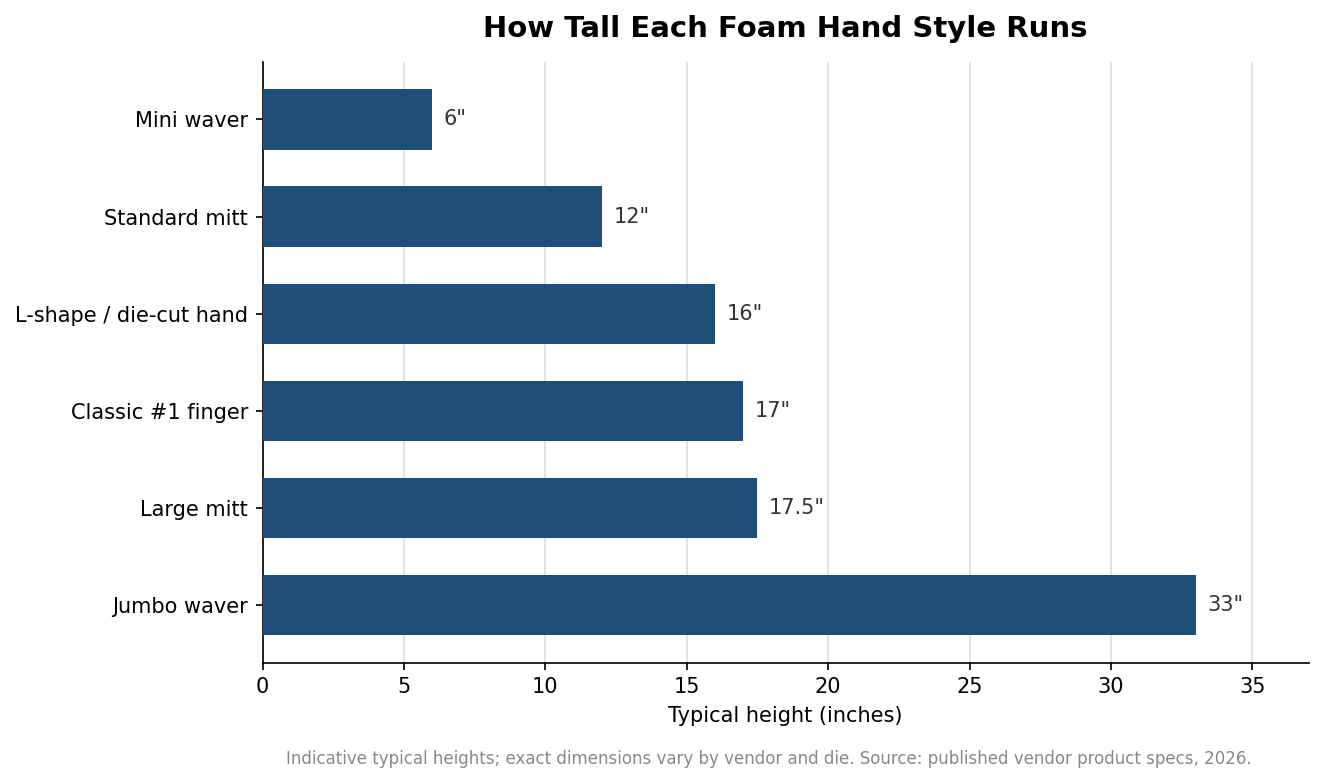
The practical trade-off is straightforward: bigger shapes command attention and carry more print area, but they cost more per piece and ship in far larger cartons. For a stadium giveaway where budget and freight are the constraints, a mid-size hand is often the sweet spot. For a hero photo or a stage moment, the jumbo earns its keep even at low quantity.
What each style costs, and how quantity moves the price
Pricing tracks size, print complexity, and above all quantity. As an order-of-magnitude picture, small wavers can run well under a dollar each in volume, standard hands and mitts commonly fall in the roughly $1 to $4 per unit band for a single-color imprint, and large or fully custom die-cut pieces sit higher. Nearly every vendor also charges a one-time setup or screen fee in the neighborhood of $50 to $60 per color and location, which is why per-unit price drops sharply as the run grows and that fixed cost spreads out. The line below, drawn from one published die-cut price schedule, shows how a run climbing from 100 to 500 units pulled the per-piece price down from about $3.80 to $3.30.
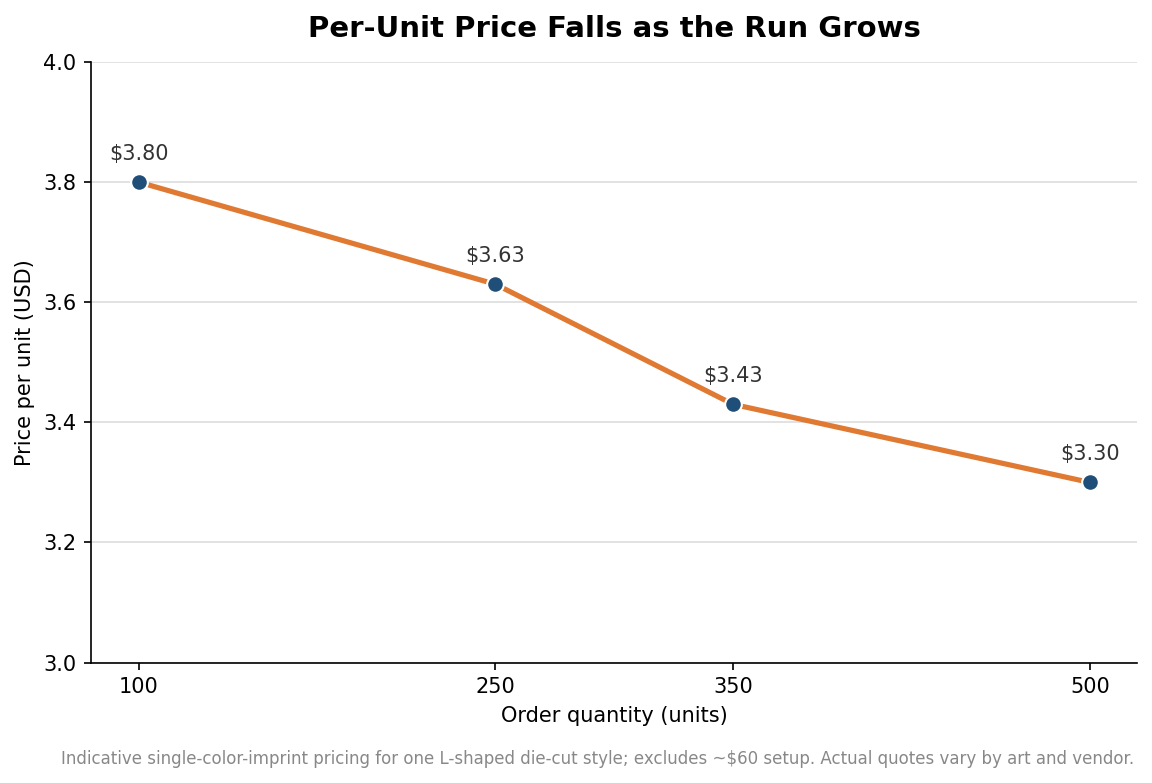
Two things follow from this. First, small orders are dominated by setup fees, so if you can consolidate several events into one print run you will save real money. Second, added colors and second-side printing each carry their own charges, so a two-color logo on both faces is a meaningfully different quote than a one-color front. Ask for pricing at the exact quantity and imprint you expect, not a round number, because the breakpoints move the math.
Materials, safety, and matching the style to your event
Across shapes the construction is similar: an open-cell foam, most often a polyurethane, cut and printed on both faces. For indoor arenas and any audience that includes children, look specifically for foam described as flame-resistant and inks described as phthalate-free, both of which reputable manufacturers will state plainly; if a listing does not mention them, ask before you commit. Print is typically a one-color screen imprint as standard, with full-color heat transfer available as an upgrade when your art demands it, at a per-unit run charge on top of the base price.
Putting it together, the style choice comes down to the job. Choose the classic pointing hand when you want one loud, universal message and the fastest, cheapest path to a big crowd. Choose a stock mitt when a recognizable gesture, thumbs-up, paw, heart, or open palm, does branding work the print alone cannot. Reserve a fully custom die cut for campaigns where the silhouette itself is the hook and the budget and timeline allow the extra tooling. Match the size to whether you are optimizing for giveaway volume or for the photograph, get a quote at your real quantity and imprint, and the shape that fits your event will usually be obvious once you have framed it that way.
Leave a Reply