The best stadium giveaway is the one that survives the drive home. Foam fingers, thundersticks, and rally towels all put a logo in tens of thousands of hands on game day, but they behave very differently once the final whistle blows — and they cost, print, and pack very differently before it. If you are choosing between them for a team night, a sponsor activation, or a campus event, the decision comes down to four practical variables rather than gut feel.
What each one is actually good at
A rally towel is a flat, sublimated cloth that a fan waves overhead and then keeps in a gym bag for years. A thunderstick is a pair of inflatable plastic tubes that make noise and cost almost nothing, but they are loud precisely because they are disposable. A foam finger is the giveaway with physical presence: it is large, it photographs well on a broadcast crowd shot, and it becomes a souvenir rather than trash. None of the three is strictly better; they occupy different points on the same axes of cost, branding space, and keepsake value.
Getting the match right matters because the giveaway is standing in for your brand. A sponsor who hands out something fans quietly discard has paid for a few seconds of visibility. One who hands out something fans photograph and keep has bought weeks or years of it. The rest of this comparison puts numbers to that trade.
Cost and quantity
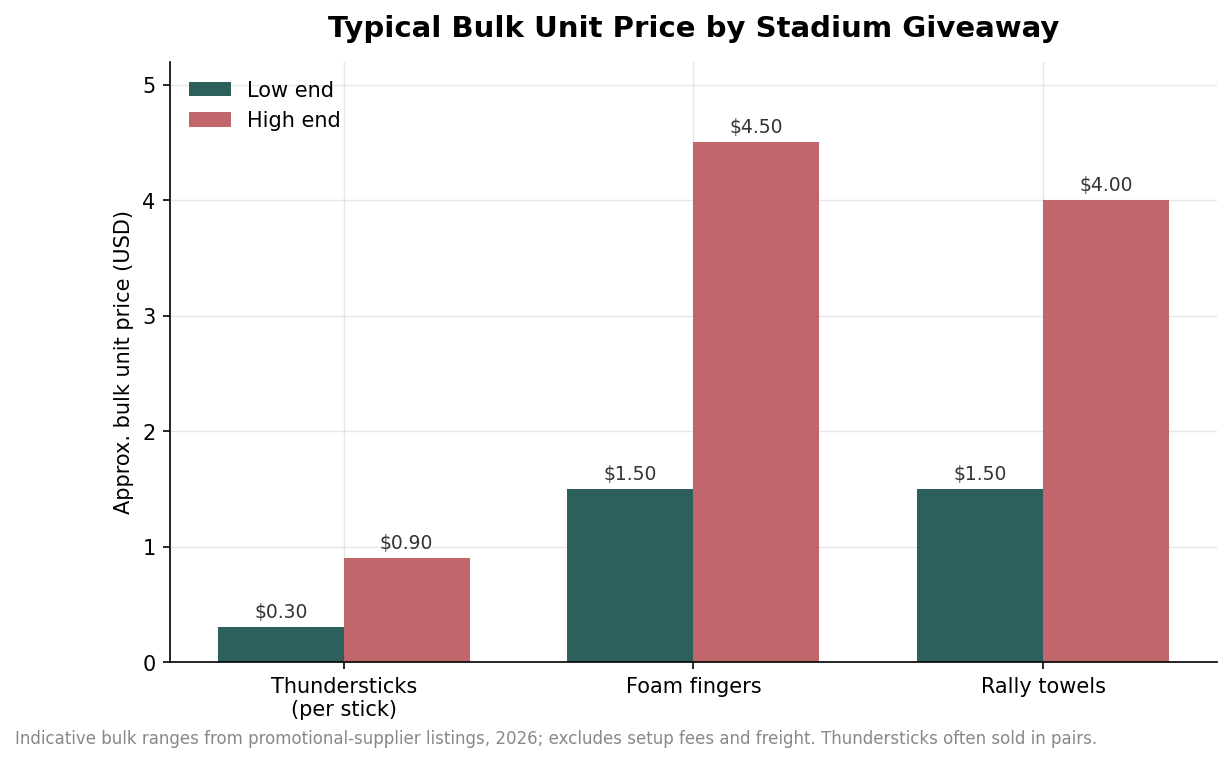
Unit price is where the three separate most sharply. Inflatable thundersticks are the budget option by a wide margin, commonly landing under a dollar per stick in bulk, which is why they suit giveaways in the tens of thousands where the only goal is noise and a splash of color. Foam fingers and rally towels sit in a similar, higher band — indicatively $1.50 to $4.00 or more each in volume — because both carry a real print and a real physical footprint.
Those figures are the piece price only. Screen or sublimation setup fees, art charges, and freight all sit on top, and freight in particular scales with bulk and weight: towels and foam fingers ship heavier and larger than deflated sticks, so a five-figure order can shift a full freight class. When you compare quotes, compare landed cost per usable unit, not the headline piece price, because the cheapest sticker rarely stays cheapest once setup and shipping are added.
Imprint area and print quality
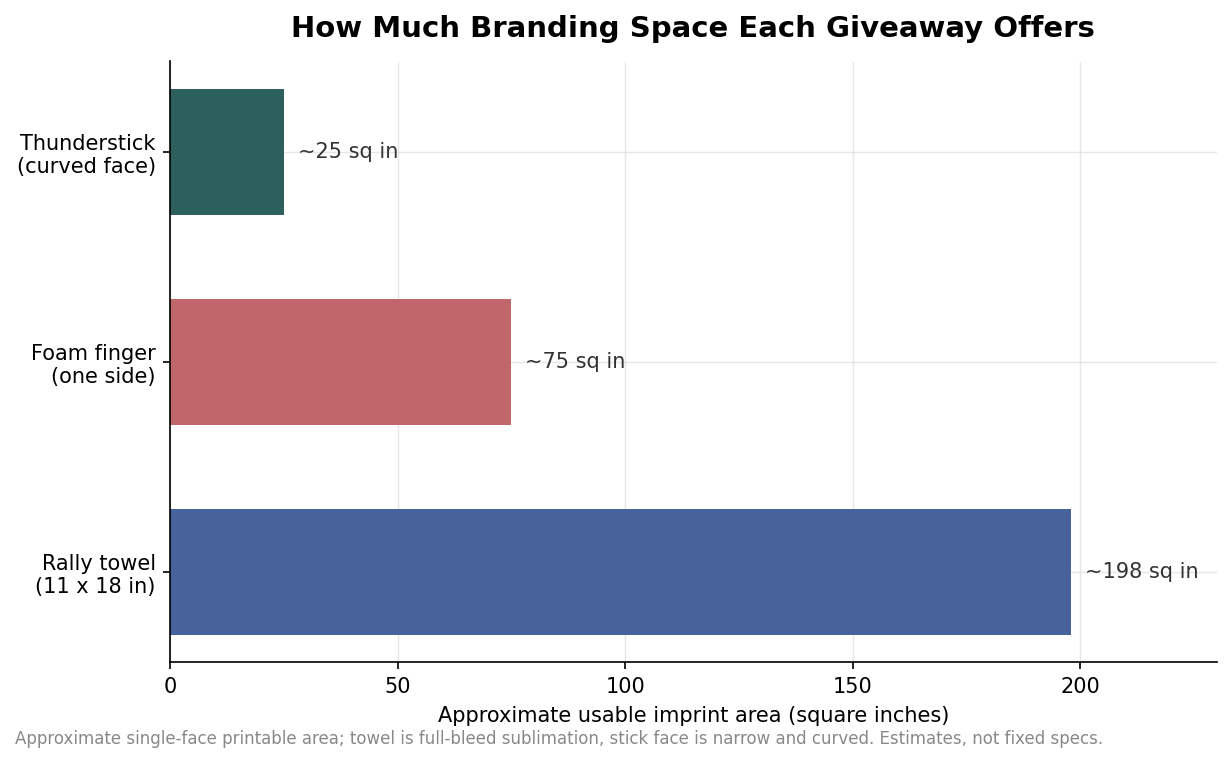
Branding space is where foam fingers and towels pull ahead. A rally towel prints edge to edge by dye sublimation, so an 11 by 18 inch towel offers roughly 198 square inches of full-color, photo-quality canvas with no per-color fee. A foam finger gives you a large single panel on each side — on the order of 75 square inches of usable space — that holds a bold logo and a short message cleanly. A thunderstick, by contrast, prints on a narrow, curved face that limits art to something simple; complex logos distort on the tube, and effective imprint area is a fraction of the other two.
The lesson is to match artwork to surface. A detailed, multi-color sponsor lockup belongs on a towel or a foam finger, where it will actually read. A single-color wordmark or a school color block is all a thunderstick can carry well, and trying to force more onto it produces a muddy result that undercuts the whole point of the giveaway.
Keepsake value and the fan’s twenty-four hours
The sharpest difference is what happens after the event. Industry write-ups on game-day promotions note that thundersticks are frequently discarded within about a day, while a well-made rally towel can stay in circulation for years. Foam fingers land between the two but far closer to the towel: they are bulky enough to be a deliberate keepsake, they show up in photos, and they tend to migrate to bedroom walls and office shelves rather than the bin. If your measure of success is impressions per dollar over time rather than noise in the moment, longevity is the variable that quietly decides it.
That does not make thundersticks a mistake. For a playoff whiteout or a coordinated crowd effect across a full arena, cheap and loud is exactly the brief, and reusability is beside the point. The error is using disposable economics for a keepsake goal, or keepsake economics for a one-night noise effect. Decide which you are buying before you compare prices.
Matching the giveaway to the event
Work backward from the outcome you want. If the goal is a dramatic, arena-wide visual on the cheapest possible budget and you are giving away enormous quantities, thundersticks earn their place. If the goal is a durable, full-color canvas that fans keep and re-use, a rally towel is hard to beat, and its 100-unit minimums make it viable even for smaller programs. If the goal is broadcast presence, a memorable souvenir, and a big readable logo — the item a kid actually wants — a foam finger delivers physical impact that neither of the others matches, at a comparable unit cost to a towel.
Most programs do not have to choose only one. A common pattern pairs a low-cost noise item for the full crowd with a smaller run of a premium keepsake for a specific section, sponsor tier, or giveaway night. Whatever mix you land on, put the real numbers — landed unit cost, usable imprint area, and expected lifespan — next to each other before you commit. The giveaway that looks cheapest on a quote is not always the one that carries your brand the furthest.
Leave a Reply